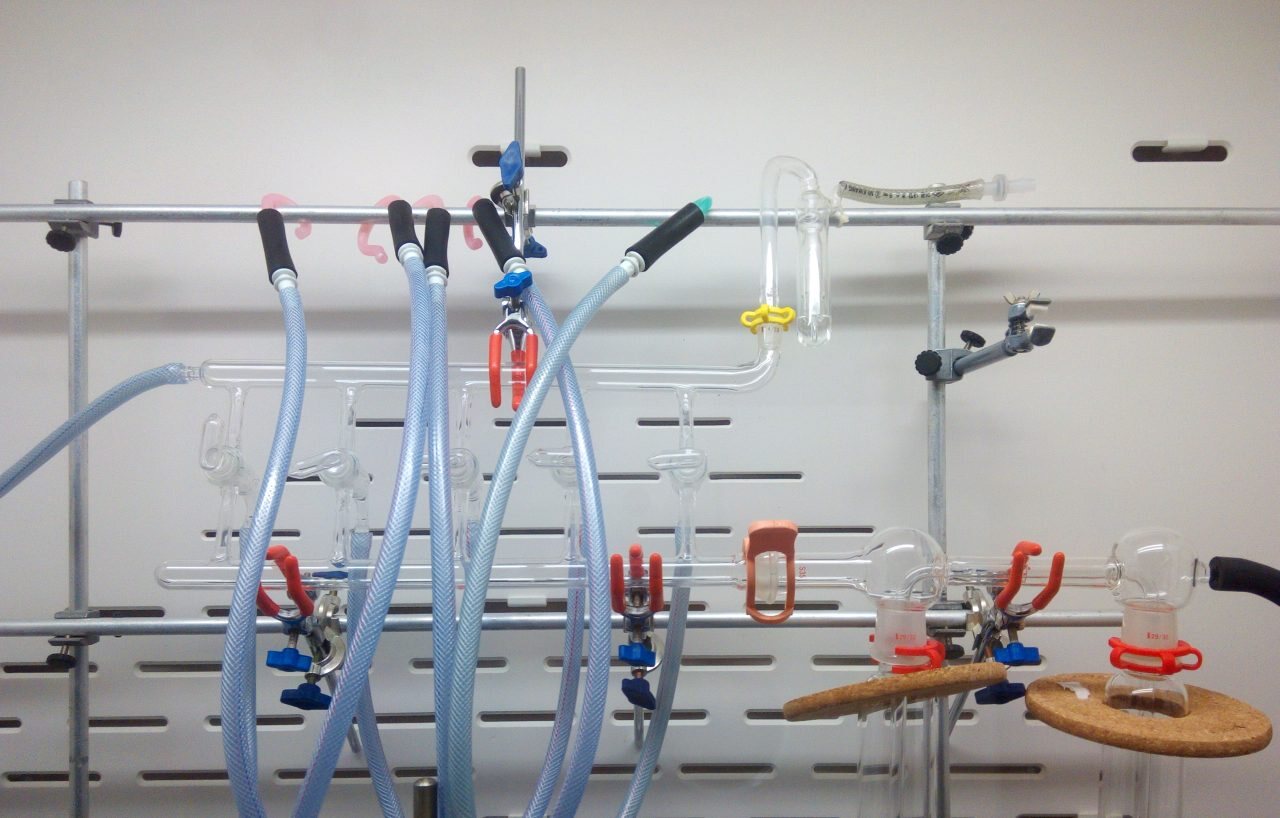
Our work sits at the intersection of fundamental coordination chemistry and practical applications in catalysis and material science.
Ligand Design
Our research in ligand design focuses on developing tailored N-heterocyclic carbene, imine, and amide ligands, with an emphasis on ligand functionalization, donor-flexible ligand frameworks, and the exploration of new carbenes beyond classical NHCs, including mesoionic and remote carbenes. By tuning electronic and steric properties, these ligands are designed to control metal coordination, reactivity, and selectivity, while enabling new reactivity, stabilizing sensitive metal centers, and supporting applications in catalysis, synthesis, and materials chemistry.
Electronic Parameters
The Huynh Electronic Parameters (HEPs) quantify the electronic influence of a trans-ligand L on the ¹³C carbene NMR signal of the ⁱPr₂-bimy reporter ligand. Stronger donors lead to a weaker palladium(II)–NHC bond, resulting in a downfield shift. HEPs enable comparison of neutral and anionic, mono- and bidentate Werner-type ligands as well as organometallic ligands on a unified scale.
These ligand platforms are applied to catalysis, with a focus on developing metal complexes that can promote C–C coupling, C–H activation, hydroelementation, and alcohol activation. By fine-tuning ligand electronics and sterics, they help control reactivity and selectivity, stabilize key intermediates, and enable more efficient catalytic transformations.
Organometallic Precursors
We also focus on the development of organometallic complexes for ALD and CVD applications in the semiconductor industry. This work involves designing precursors with the right balance of volatility, thermal stability, and reactivity to support precise thin-film deposition, with the goal of improving film uniformity, purity, and overall process control for advanced semiconductor materials.